The gorilla trekking rules in Uganda, and why they exist
Every gorilla trek in Uganda follows the same set of rules, read out at the early morning briefing. Most of them protect the gorillas from us rather than the other way round. Below you will find each rule with the reason behind it, and what it changes about your hour in the forest.
Why the rules exist
Mountain gorillas share most of our DNA, and that closeness has a cost. They catch human illnesses, and a cold that gives you a sore throat can spread through a family with no medicine to stop it.
Only about 1,000 mountain gorillas live in the wild, roughly half of them in Bwindi Impenetrable National Park. The Uganda Wildlife Authority (UWA) sets the rules, and rangers enforce them on every trek.
The briefing before you set off
Every trek begins with an early morning briefing at the park office. A ranger explains the rules, checks permits and passports, then assigns each group to one habituated family.
You cannot choose your family or know how far away it slept. According to many operators, rangers do try to pair slower hikers with a nearer group, so tell them at the briefing if the climb worries you. Our page on how hard the trek is goes into the terrain.
Porters and walking sticks are sorted at this stage too. Hiring a porter breaks no rule and helps on the slopes, and it leaves your hands free when the ranger asks the group to stop.
Seven meters (23 feet)
Keep about 7 meters (23 feet) between you and the nearest gorilla. The gap gives the animals room and keeps your breath away from their faces.
Habituated gorillas do not always respect the line themselves. A youngster may wander past within arm's reach, or a mother may cross the path in front of you. Stay calm, and back away slowly if the ranger tells you to.
Masks may be handed out or asked for near the family. Wear one if requested, since it is a cheap barrier against the infections the whole system is built to avoid.
One hour once you find them
The clock starts when your group reaches the family and stops sixty minutes later. The walk to find them is not counted, and it can take from under an hour to most of the day.
An hour limits the stress on the gorillas, who meet one visitor group a day. If sixty minutes sounds short, our page on four hours instead of one describes the longer habituation visit in Bwindi.
Age 15, and healthy on the day
The minimum age is 15, with no exceptions for tall or fit children. Families with younger kids can split the day, with one parent trekking while the other stays at the lodge.
Do not trek if you are ill. Rangers can turn back anyone with a cough or a fever, and refunds depend on UWA rules and your operator. Our guide to the gorilla permit covers what happens to your booking.
How to behave near the family
Groups are capped at 8 visitors per family per day, so the space is shared. Keep your voice low and move slowly. Stay with the group rather than circling around for a better angle.
- No flash photography, ever
- No eating or drinking near the gorillas
- Turn away and cover your mouth to cough or sneeze
- No pointing, waving or sudden movements
- Never touch a gorilla, even one that comes close
- Follow the ranger's instructions without debate
Food stays in your bag until the group has moved well away. Our packing list for the trek explains why the camera should already have its flash switched off before you set out.
When nature calls on the trail
There are no toilets in the forest. Use the facilities at the park office before the briefing, and tell the ranger if you need to stop later.
The ranger will lead you away from the path and the family. Dig a small hole and cover it afterwards, so nothing human is left where gorillas feed.
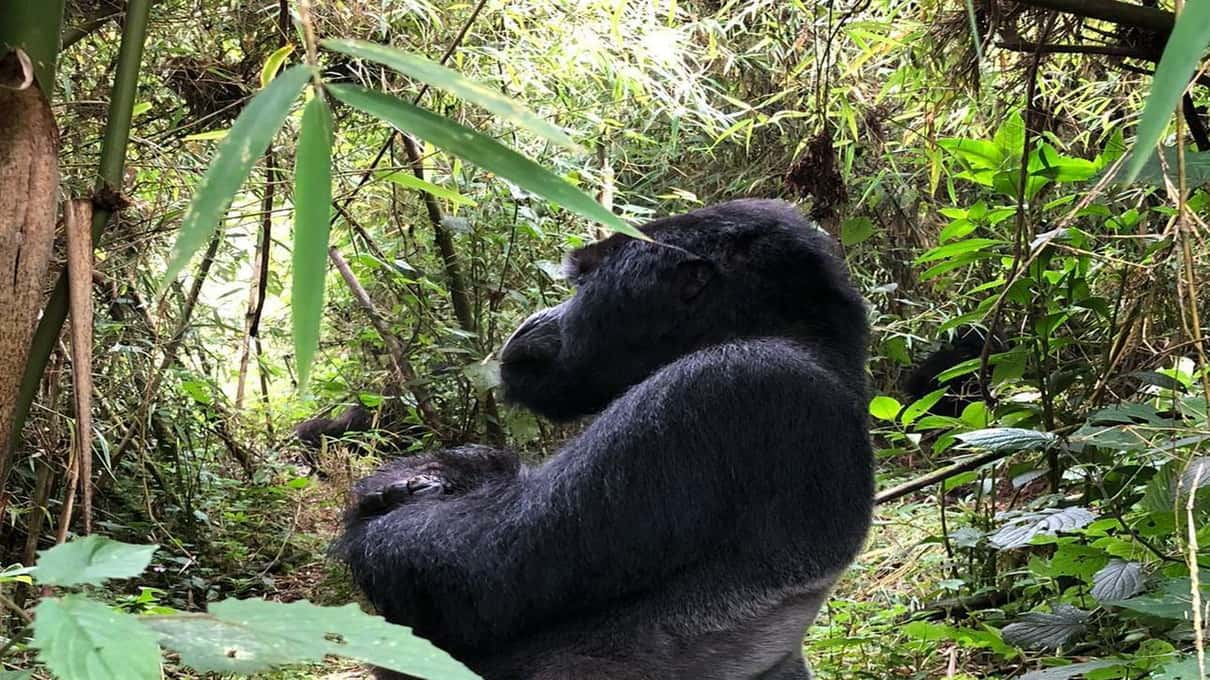
If a silverback charges
Silverbacks sometimes rush toward visitors with a roar and a beat of the chest. It is frightening, and the advice rangers give is clear about what to do next.
Stay still and look down, crouch low and let the ranger take the lead. Do not run, since running is what a threat looks like to a gorilla. The ranger knows the family's moods and will tell you when it is safe to move.
Rangers ask you to lower your eyes because a direct stare can read as a challenge. Keep the rest of the group close behind you and let the moment pass.
A ranger leads every group
Each trek has a UWA ranger or guide at the front, and the rules above are theirs to enforce. On Kawira Safaris' day trip from Kigali at ~$400, the listing names a UWA ranger among the inclusions. The $800 gorilla permit and a Uganda visa are extra on that price.
The trip runs to Mgahinga Gorilla National Park in a private 4x4 with an English-speaking driver-guide, and holds 4.9 from 26 reviews on GetYourGuide. The price for the convenience is a very long day, starting before dawn with a border crossing in each direction.
One day, one family, one ranger
Kawira Safaris runs a same-day return from your Kigali hotel to Mgahinga, covering lunch and park entry. Budget for the gorilla permit and the visa on top.
Coming from Uganda's side instead, the rules are identical in Bwindi. Our day trip from Kigali page compares that route with a longer stay, and our page on when to trek helps you pick the week.